> For the complete documentation index, see [llms.txt](https://docs.aethra.work/llms.txt). Markdown versions of documentation pages are available by appending `.md` to page URLs; this page is available as [Markdown](https://docs.aethra.work/on-chain-infrastructure.md).
# On-Chain Infrastructure
AETHRA relies on Ethereum mainnet to provide the trust, transparency, and security required for workforce coordination at scale. By anchoring credentials and governance directly on-chain, the system avoids single points of failure and guarantees verifiability across industries.
***
## Why On-Chain
Trust at scale
Credentials and decisions are anchored on Ethereum, making tampering impossible without detection.
Global interoperability
Works with wallets, custody providers, and developer tools out of the box.
Future-ready security
Ethereum’s decentralization and EVM compatibility provide a foundation strong enough for enterprise use.
***
### What Lives On-Chain vs Off-Chain
{% tabs %}
{% tab title="On-Chain (trust anchors)" %}
* Credential proofs and revocation status
* Staking and incentive logic
{% endtab %}
{% tab title="Off-Chain (intelligence & privacy)" %}
* AI-matched talent recommendations
* Scheduling, predictive planning, and compliance workflows
* Personal data and credential details (kept encrypted and private)
{% endtab %}
{% endtabs %}
{% hint style="success" %}
Compliance, automated. Sensitive data never touches the chain; only cryptographic proofs and anchors are published.
{% endhint %}
***
## How It Works (Simplified Flow)
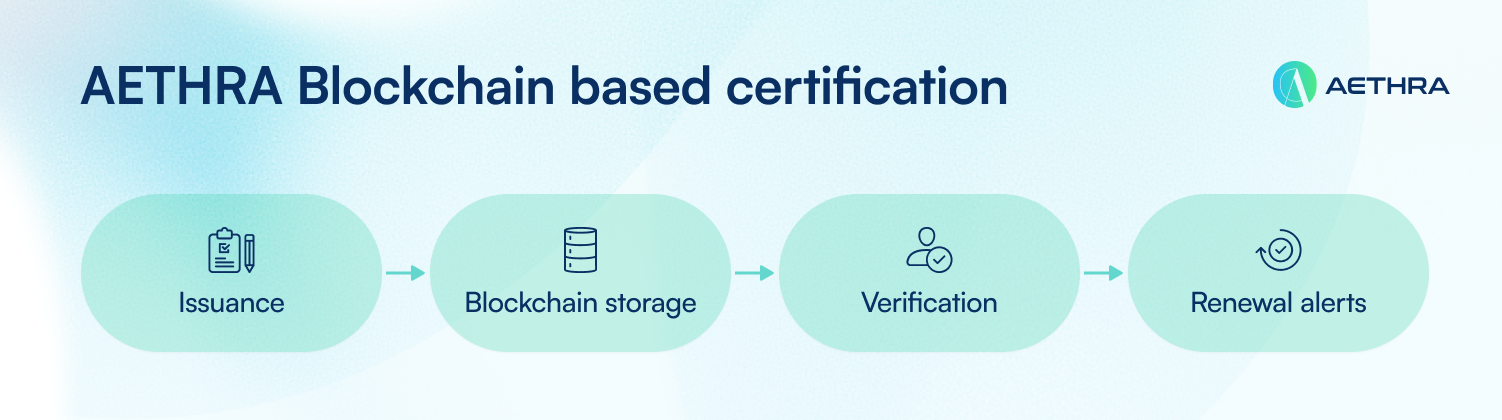
1. Credential issued → An organization validates a worker’s credential.
2. Anchor recorded → A non-reversible proof is written to Ethereum.
3. Verify anywhere → Any stakeholder can confirm authenticity by checking the anchor without exposing private data.
4. Stake & govern → $AETHRA tokens align participants, secure the system, and (later) enable protocol-level decision-making.
***
## Security Principles
* Proof over promises: Trust is verifiable, not assumed.
* Least-data principle: Only the minimum state needed for validation is stored on-chain.
* Transparent governance: Protocol evolution will be community-aligned, with safeguards and accountability built in.
{% hint style="info" %}
*Workforce intelligence demands more than speed, it demands trust without shortcuts. AETHRA delivers that trust on-chain.*
{% endhint %}
---
# Agent Instructions
This documentation is published with GitBook. GitBook is the documentation platform designed so that both humans and AI agents can read, navigate, and reason over technical content effectively. Learn more at gitbook.com.
## Querying This Documentation
If you need additional information that is not directly available in this page, you can query the documentation by asking a question.
Perform an HTTP GET request on the following URL with the `ask` and `goal` query parameters:
```
GET https://docs.aethra.work/on-chain-infrastructure.md?ask=&goal=
```
`ask` is the immediate question: it should be specific, self-contained, and written in natural language.
`goal` is what the user is ultimately trying to achieve, the reason they need the answer. Sharing it helps GitBook give you a better, more relevant answer. A goal is most helpful when it describes the outcome the user wants rather than restating the question. For example, with `ask=how do I create an API token`, a goal like `automate deployments from our CI pipeline` lets GitBook tailor the answer to that use case.
The response will contain a direct answer to the question and relevant excerpts and sources from the documentation.
Use this mechanism when the answer is not explicitly present in the current page, you need clarification or additional context, or you want to retrieve related documentation sections.